.png)
Rapid Reports
The Future of U.S. Higher Education:
Equity Implications of Shifting Immigration Policies
The Research Institute for Social Equity
This report examines the impact of U.S. immigration policies on higher education and international students from 2000 to 2025. It traces five major policy eras, from the post-9/11 security overhaul and Obama-era expansion to the restrictive turns of 2017–2020 and 2025, and analyzes how shifting regulations have influenced enrollment patterns, economic contributions, and student well-being. Despite hosting more than 1.1 million international students in 2023–2024, the U.S. share of the global student market has fallen from 20% to 16%, underscoring how policy volatility and restrictive measures weaken national competitiveness. Drawing on federal data, scholarly research, and institutional reports, this analysis highlights inequities rooted in nationality, income, and academic discipline, as well as the psychological toll of prolonged uncertainty. The report concludes with equity-driven policy recommendations for federal, state, and institutional actors to restore stability, protect mental health, and reaffirm the United States’ role as a global leader in education and innovation.
For decades, the United States has been the world’s premier destination for international students seeking higher education. However, this long-held leadership position now faces significant challenges from intensifying global competition and volatile domestic immigration policies. This report examines the impact of these policies on U.S. higher education, particularly on the international students it serves, with a specific focus on the equity implications.
In 2025, the U.S. government introduced at least six major immigration policies specifically targeting international students, marking a significant shift in the regulatory landscape for global education. During the 2023–2024 academic year, U.S. higher education institutions hosted a record-high enrollment of more than 1.1 million international students [1]. Despite this milestone, the figure masks a downward trend: over the past decade, the United States’ share of the global international student market has declined from 20% to 16%. In contrast, competitor countries enroll substantially higher proportions of international students relative to their total student populations, 31% in Australia, 27% in the United Kingdom, and 38% in Canada, compared with just 6% in the United States.
This report examines how the constantly changing U.S. policy landscape poses significant risks to students, undermines national competitiveness, and raises serious concerns about equity. By analyzing two decades of policy shifts and their consequences, we identify a path toward a more stable, welcoming, and strategic approach to international education.
KEY TAKEAWAYS
Recent shifts in U.S. immigration policy have created an unstable environment for international students, affecting their ability to study, work, and remain in the country.

Policy volatility shapes students’ academic pathways, mental health, and long-term planning, particularly for those from the Global South who already face higher structural barriers.
Institutional processes, including compliance with the Student and Exchange Visitor Information System (SEVIS), visa documentation, and work authorization rules, continue to impose unequal burdens based on nationality and economic background.
Policy uncertainty threatens U.S. competitiveness by discouraging global talent and pushing students to consider alternative destinations with more predictable post-graduation pathways.
Addressing these challenges requires coordinated federal, state, and institutional efforts to stabilize immigration processes, clarify documentation, and support student success.
IMMIGRATION POLICY LANDSCAPE IN THE U.S.: 2000–2025
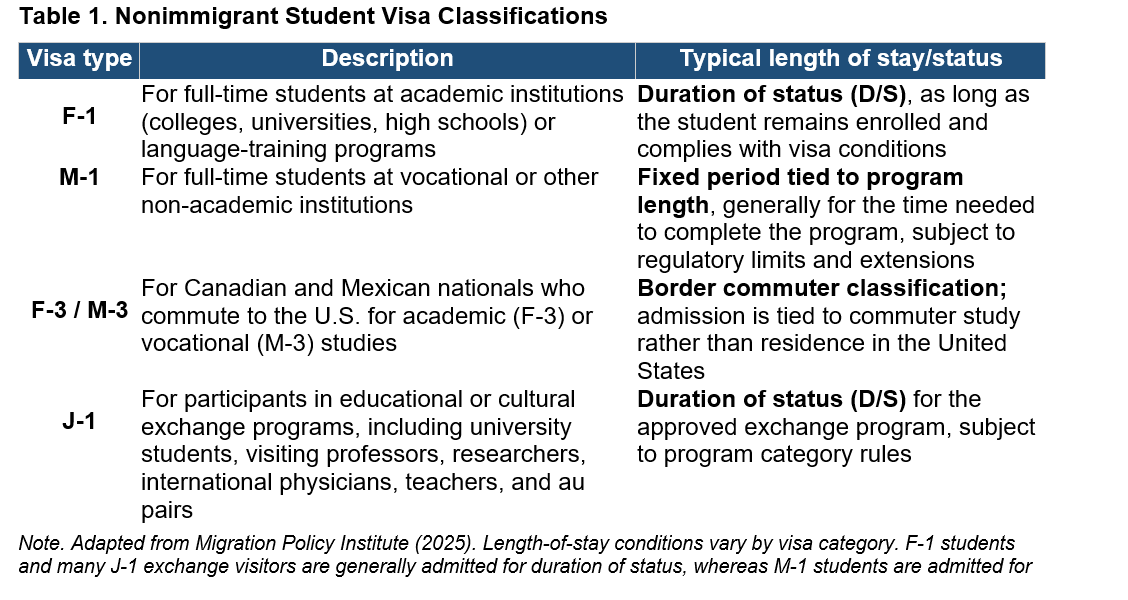
International students must obtain a visa to study in the United States. These visas provide formal authorization to enter and remain in the country for educational purposes. Different visa types apply to international students depending on the purpose and structure of their academic program, as well as the funding sources supporting their training in the United States. Table 1 summarizes the primary visa categories applicable to international students in the United States. Each visa category defines eligibility criteria, work authorization, institutional oversight requirements, and permissible activities during study, reflecting their close connection to U.S. immigration policy. Understanding these primary visa categories helps contextualize the U.S. policy landscape discussed below.
The Immigration Policy Shifts from 2000 to 2025
The immigration policies from 2000 to 2025 have been marked by dramatic shifts driven by national security priorities, economic needs, and changing political ideologies. These swings between welcoming and restrictive postures have created a volatile environment for both students and institutions in the U.S. The foundational architecture for student visas was established in the mid-20th century with the Immigration and Nationality Act of 1952 [2].
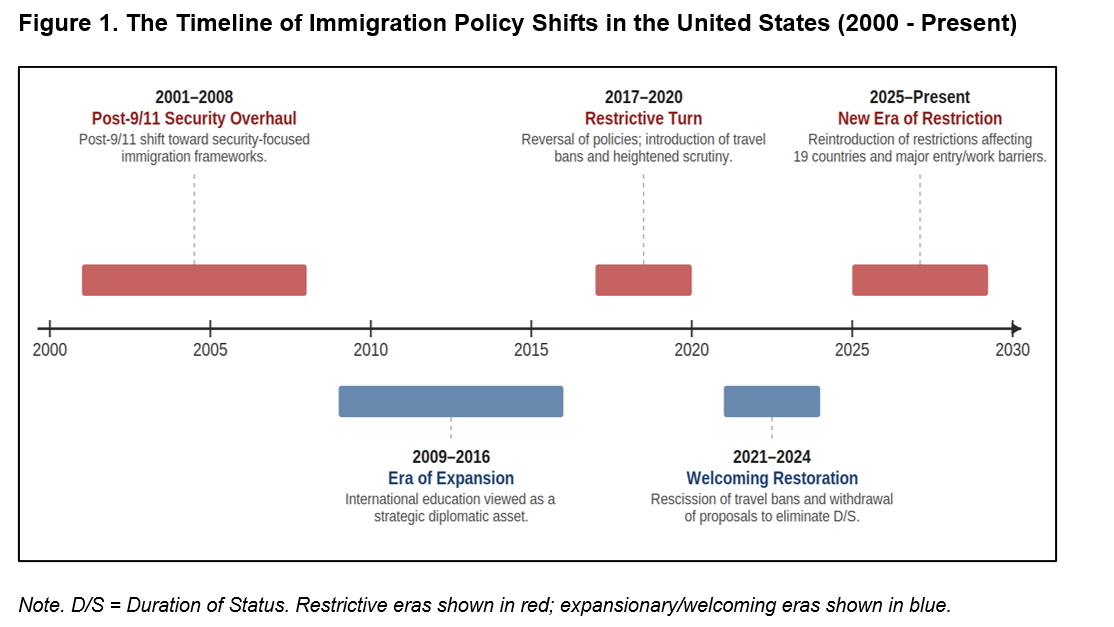
The policies included in this timeline represent the most consequential structural turning points in U.S. immigration governance affecting international students between 2000 and 2025 (see Figure 1). Each policy shift, whether restrictive or expansionary, produced measurable impacts on visa approval rates, employment pathways, institutional compliance requirements, and global perceptions of the United States as a study destination.
2001-2008: Post-9/11 Security Overhaul. The September 11 attacks triggered a fundamental shift toward security-focused immigration policy. This era saw the creation of the Student and Exchange Visitor Information System (SEVIS), a web-based tracking system that transformed universities into partners in immigration compliance [3, 4]. To retain talent, this period also introduced a 17-month Optional Practical Training (OPT) extension for Science, Technology, Engineering, and Mathematics (STEM) graduates.
2009-2016: Era of Expansion. The Obama administration viewed international education as a strategic asset and expanded pathways for skilled graduates. The most significant action extended the STEM OPT period from 17 to 24 months, thereby allowing STEM majors up to 3 years of post-graduation work authorization [3, 5]. This policy reinforced the United States’ position as a leading destination for global STEM talent and contributed to the demographic reality that over half of international students in the U.S. pursue STEM degrees.
2017-2020: Restrictive Turn. The first Trump administration marked a sharp reversal from the expansion era. Key policies included travel bans targeting several Muslim-majority countries, heightened visa scrutiny, and a formal proposal to eliminate duration of status [6, 7, 8]. In July 2020, an ICE directive affecting students at institutions that moved online during COVID-19 was later rescinded following legal and political challenges.
2021-2024: Welcoming Restoration. The Biden administration reversed many previous policies, rescinding travel bans, withdrawing the proposal to eliminate the duration of status, and easing the subjective “non-immigrant intent” requirement, which had been a significant barrier to visa approval [9, 10, 11].
2025- Present: New Era of Restriction. The second Trump administration reintroduced restrictive measures affecting international students and the broader student-to-work pipeline, including a new travel ban affecting nationals of 19 countries, a wave of abrupt visa revocations, and major changes to high-skilled migration policy. Most notably, a September 2025 presidential proclamation imposed a $100,000 payment requirement for many new H-1B petitions, the principal temporary U.S. work visa for specialty occupations and a common post-study employment pathway for some international graduates in the United States [6, 12, 13, 14]. Below are major policies, including executive actions and administrative measures, enforced or proposed this year that have significant implications for international students.
- Student Visa Security Improvement Act (H.R. 414) (January 15, 2025): This proposed bill would impose new requirements related to background checks, monitoring, and program oversight for international students, including more rigorous Department of Homeland Security review of student visa applications and enhanced reporting requirements for certain student status changes, such as transfers or changes of major. As of this writing, H.R. 414 was introduced in the House and referred to the House Committee on the Judiciary, but it has not been enacted. [50]
- Attempt to End Birthright Citizenship (Executive Order 14160, January 20, 2025): This proposal sought to revoke birthright citizenship for individuals born on U.S. soil to non-citizen parents and to restrict federal agencies from issuing citizenship documentation when an individual’s father is neither a U.S. citizen nor a lawful permanent resident and the mother is undocumented or holds a temporary status, such as a student or work visa. [51]
- Enhanced Screening and Vetting (Executive Order 14161, January 20, 2025): This policy mandates increased screening and vetting for individuals seeking admission to the United States, including F-1 and J-1 students and other visa holders. As a result, international students remain subject to heightened scrutiny under a policy framework that emphasizes national security concerns. [52]
- Suspension of Funding for Programs and Grants (February 12, 2025): On February 12, 2025, the U.S. Department of State implemented a temporary pause on certain grant disbursements as part of an “America First” review process, affecting current and future payments for State Department-funded international exchange and study abroad programs. Programs such as Fulbright and the International Development Education Awards (IDEAS) were among those affected, and funding disruptions reportedly continued beyond the original 15-day pause. [49]
- Fairness for High-Skilled Americans Act of 2025 (March 25, 2025): This policy would eliminate the Optional Practical Training (OPT) program and any successor program absent express authorization from Congress. OPT currently allows F-1 visa holders to gain temporary employment related to their field of study, often before or after graduation. Eliminating OPT could significantly reduce work opportunities that many international students rely on to gain professional experience and support their education. [53]
- Halt of Visa Interview Scheduling (May 27, 2025): The U.S. Department of State directed all U.S. embassies and consulates to suspend the scheduling of new visa interviews for international students. Although the pause was lifted on June 18, 2025, the Department introduced new prioritization criteria that included expanded social media screening for international student applicants. [54]
- SEVIS Record Terminations and Visa Revocations (March–April 2025): Beginning in mid-March 2025, SEVIS records and visas were terminated, often with limited explanation.. In April, U.S. Immigration and Customs Enforcement (ICE) revoked SEVIS records and visas for thousands of international students and scholars, frequently without clear procedural safeguards. Many of the terminations were reversed, and SEVIS records were restored in late April. This policy’s rapid reversals and inconsistent implementation had significant negative impacts on international students. [55, 56, 57]
- Travel Ban (June 4, 2025): President Trump signed Presidential Proclamation 10949, imposing a travel ban on nationals of 12 countries, with additional immigration restrictions on nationals of seven others. On June 14, 2025, Secretary of State Marco Rubio expanded the list to include 25 African countries, as well as select Caribbean, Central Asian, and Pacific Island nations. The ban applied to international students and scholars holding or applying for F-1, J-1, or M-1 visas. [58, 59, 60]
- One Big Beautiful Bill Act (OBBBA) (July 4, 2025): This legislation had significant implications for higher education, including increased constraints on institutional funding and proposed changes affecting college endowments. Because endowment resources often help support institutional aid and scholarships, these changes could indirectly reduce universities’ capacity to support international students. [61, 62]
- CFR Part 214—Nonimmigrant Classes: Student and exchange visitor visas are granted for duration of status (i.e., as long as the student remains enrolled and complies with regulatory requirements) under current regulations. The Department of Homeland Security (DHS) has proposed a rule to replace the current “duration of status” framework with a fixed maximum period (e.g., four years), which would limit how long foreign students may remain in the United States; however, this proposal has not been finalized. [63, 64]
U.S. Global Competitiveness in International Education Policy
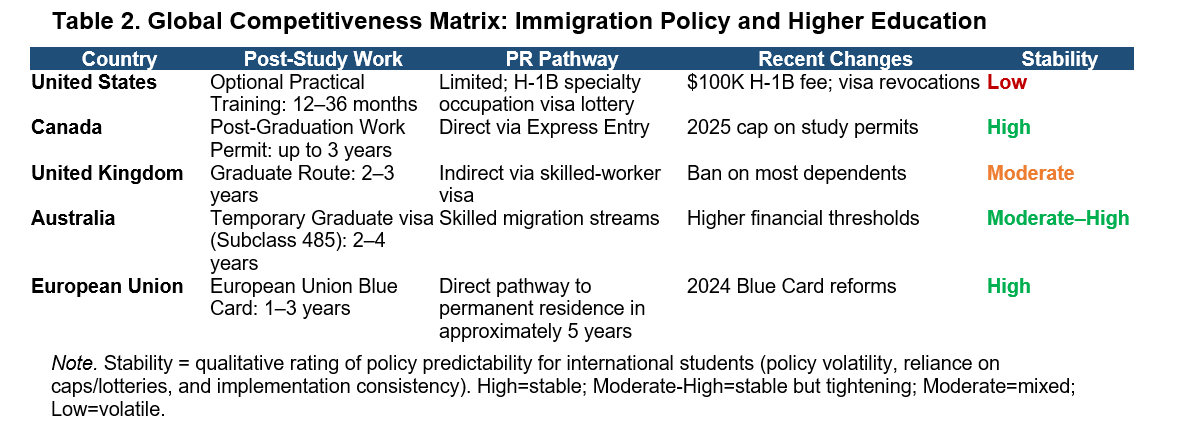
In today’s global higher education environment, every major host country is recalibrating its immigration policies to balance economic growth, labor needs, and social priorities. Amid these shifts, the United States’ volatility remains its most significant competitive weakness. While other nations are tightening entry criteria, they often maintain more predictable and structured pathways that enhance their appeal to international students. The comparator countries included in Table 2 were selected because they are widely recognized as major host destinations for international students and as principal competitors with the United States in the global higher education market. Table 2 outlines the key policies affecting international students in the United States and these comparator countries; the stability rating summarizes policy predictability using the criteria described in the Table 2 note.

THE ENROLLMENT TREND OF INTERNATIONAL STUDENTS (2009–2024)
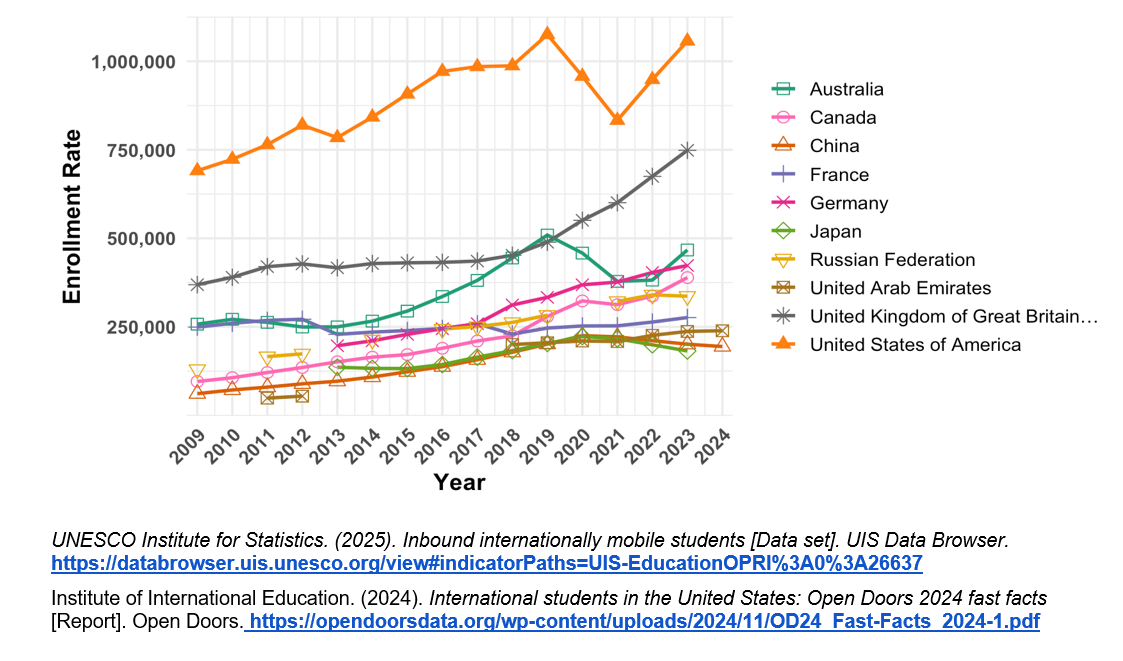
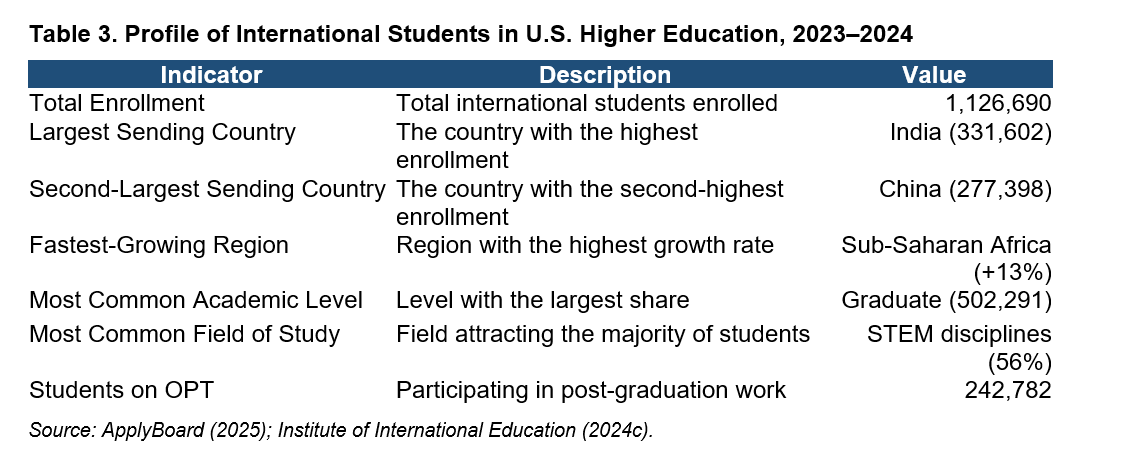
International students are among the groups most significantly affected by immigration policies, and the effects are particularly pronounced in the U.S., as it hosts the largest number of international students worldwide (e.g., over 1.1 million enrollment during the 2023-2024 academic year, according to Table 3). International students accounted for about 6% of the higher education enrollment in the United States [16]. As shown in Figure 2, the United States hosted the largest number of international students among the top ten destination countries worldwide over the past decade (2013–2023). The United States consistently enrolled significantly more international students than the United Kingdom, the second-largest host country, although the gap narrowed substantially during the COVID-19 pandemic.
International student mobility across major host countries fluctuated between 2009 and 2024 (Figure 2). The figure draws on UNESCO Institute for Statistics (UIS) data and IIE’s Open Doors Fast Facts for inbound internationally mobile students, which capture cross-border movement for study and illustrate a clear pandemic-era disruption followed by recovery across leading destinations. For the United States specifically, Open Doors (IIE/U.S. Department of State) shows growth through the mid-2010s, a modest decline in 2019/20 (-1.8%), a sharper drop in 2020/21 (-15.0%), and a sustained rebound thereafter (2022/23: 1,057,188; 2023/24: 1,126,690) [47]. Taken together, the cross-country UIS pattern and the U.S. Open Doors trend indicate that policy environment and global shocks (especially COVID-19) are closely linked to international student mobility and enrollment outcomes.
Of the international students in the United States (see Table 3), the majority of them are from India, followed by those from China. Over half of them (56%) are in Science, Technology, Engineering, and Mathematics (STEM) disciplines, and more than 40% are graduate students. There was also rapid growth in the international students from Sub-Saharan Africa, particularly Nigeria and Ghana, indicating the diversification of global talent sources in the U.S. These students are among those who have been significantly affected by policy shifts over the past decades.
THE CASE OF VIRGINIA: INTERNATIONAL STUDENTS AND STATE-LEVEL POLICIES
International students are central to Virginia’s higher education system and economy. State-level analyses using NAFSA’s International Student Economic Value Tool estimate that approximately 21,000 international students, representing roughly 4% of total higher-education enrollment in Virginia, study in the Commonwealth. These students contribute more than $800 million annually to the state economy and support more than 8,000 jobs across higher education, housing, retail, and health care [20, 21].They are concentrated at major public research universities, including the University of Virginia, Virginia Tech, Virginia Commonwealth University, and George Mason University, as well as at private institutions and community colleges across Northern Virginia, Richmond, and Hampton Roads.
Institutional Support to international students
There has been strong institutional support for international students during periods of restrictive U.S. immigration policy. For example, many institutions in Virginia have expanded international student services, including visa advising, emergency financial assistance, and mental health resources, in response to policy volatility, travel bans, and abrupt SEVIS actions [22, 23]. One example of this broader volatility emerged in 2025, when the Trump administration proposed a “Compact for Academic Excellence” that would have conditioned federal support for the University of Virginia (UVA) on major governance changes, including capping international student enrollment at 10%, imposing an indefinite tuition freeze, and restricting diversity, equity, and inclusion (DEI) initiatives and faculty speech [24]. Although UVA did not simply accept the proposal as originally framed, the university later reached an agreement with the U.S. Department of Justice, under which the DOJ paused pending investigations while UVA agreed to compliance reporting and planned reforms related to unlawful discrimination and DEI policies [24, 65]. This episode illustrates the degree of policy uncertainty facing institutions and helps explain why institutional support remains especially important for international students, who face multiple, intersecting challenges that affect their academic success and well-being in the United States.
Gubernatorial Narratives and Higher Education Politics
State-level political narratives also shape international students’ lived experiences. During his term (January 2022-January 2026), Governor Glenn Youngkin made higher-education governance a signature issue, frequently challenging DEI programs, pressuring universities to restructure diversity offices, and using board appointments to redirect institutional priorities [34, 35]. Although these debates seldom reference international students directly, the implications are significant. Reductions in DEI staffing and pressure to narrow student support services risk weakening the offices international students rely on for climate support, advocacy, and crisis response [22, 36, 37, 35].
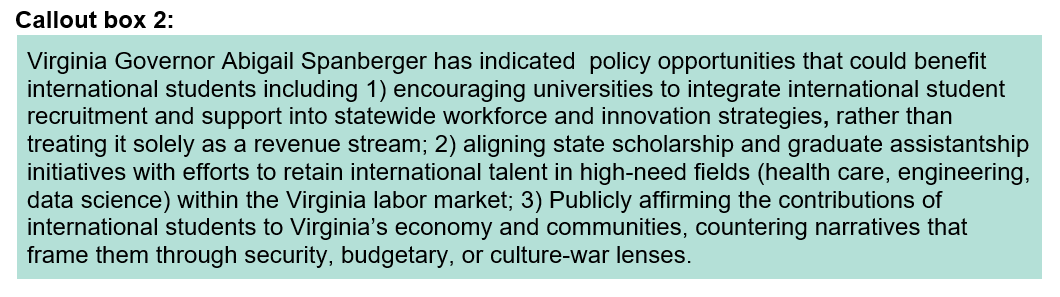
However, Virginia’s current gubernatorial leadership has signaled a contrasting approach to higher-education governance. Governor Abigail Spanberger has emphasized transparency in government, affordability, workforce development, and support for public education and public institutions [66, 67]. Although she has not articulated an international-student-specific agenda, these broader priorities suggest the following policy opportunities:
- Encouraging universities to integrate international student recruitment and support into statewide workforce and innovation strategies rather than treating them solely as revenue streams.
- Aligning state scholarship and graduate assistantship initiatives with efforts to retain international talent in high-need fields (health care, engineering, data science) within the Virginia labor market [32, 27, 20].
- Publicly affirming the contributions of international students to Virginia’s economy and communities, countering narratives that frame them through security, budgetary, or culture-war lenses [20, 38, 39].
EQUITY IMPLICATIONS
U.S. immigration volatility does not affect all international students equally. Certain groups face heightened vulnerability due to nationality-based restrictions, field of study, program length, and socioeconomic background. Understanding these disparities is essential for designing equity-centered policy responses. The following factors outline the conditions that increase international students’ vulnerability under recent policy shifts, with some examples.
- Nationality and Religion: The travel bans implemented in 2017 and 2025 explicitly targeted students from several Muslim-majority countries, disrupting thousands of academic careers [17]. The human cost is immense. Mahya, an Iranian student accepted to a PhD program, saw her plans shattered by the 2025 ban, stating: “The travel ban came up, and it was like all my dreams were worth nothing” [10].
- Academic Program: PhD students, whose programs regularly exceed four years, are particularly vulnerable to the proposed elimination of “duration of status.” This change would force them into a high-stakes, backlogged immigration adjudication process, preventing them from continuing their research [17].
- Field of Study: The majority of international students (56%) are in STEM fields, drawn by the 36-month STEM OPT extension [1]. The precarity of the H-1B visa pathway directly threatens the return on their educational investment, which is a primary motivator for their studies.
- Race and Ethnicity: Beyond official policy, many students of color report confronting racism and microaggressions in the U.S. for the first time [18]. The rise in anti-Asian hate during the pandemic, which studies linked to political rhetoric, illustrates how a hostile political climate can compound the challenges international students face [19].

As discussed above, these policy shifts and restrictions reflect systemic patterns that can disproportionately disadvantage international students and create significant barriers to navigating their daily academic, social, and economic lives in the United States. The following section examines the key challenges that emerge from this policy environment, including economic barriers, discrimination, liminal legal status, educational stratification, and mental health impacts.
- Economic Barriers: The new $250 Visa Integrity Fee and the prohibitive $100,000 H-1B fee create a two-tiered system that explicitly favors students and employers with significant financial resources [12, 14]. The $100,000 H-1B petition fee, effective September 21, 2025, applies only to new petitions filed after the proclamation date and does not affect individuals already in the U.S. under valid visa status [14, 40, 24]. This dramatically alters the human capital calculus, making the return on investment unattainable for students without significant personal or family wealth or employer backing. It also makes it nearly impossible for smaller organizations, nonprofits, and universities to sponsor U.S.-trained graduates, effectively choking off a critical talent pipeline [41].
- National Origin Discrimination: The travel bans are a clear example of a policy reinforcing inequity based on national origin and religion. By barring entry to thousands of students and scholars from specific, predominantly Muslim-majority countries, these executive orders disrupted academic careers and sent a message that a student’s country of origin could disqualify them from educational opportunities in the U.S. [15].
- Liminal Legality: “Liminal legality” refers to immigration statuses that are technically lawful yet highly unstable, leaving individuals in a persistent state of insecurity. International students often inhabit this in-between category. They are legally present in the S., but their ability to remain depends on fragile administrative processes vulnerable to delays, reinterpretations, and sudden policy shifts. Even minor bureaucratic issues, SEVIS data errors, delayed adjudications, and technical violations can jeopardize their status. This ongoing precarity affects students’ social networks, family stability, religious participation, and academic engagement [30].
- Educational Stratification: The institutional sorting of students into different academic tracks often reproduces socioeconomic and racial inequalities. International students, particularly those from lower-income regions, are disproportionately affected by this process. Unequal access to research funding, graduate assistantships, high-opportunity coursework, and mentorship opportunities channels students into different tiers of academic engagement. Students placed on lower tracks receive fewer resources, less faculty interaction, and reduced preparation for competitive graduate programs or employment [24].
- Psychological Toll as an Equity Issue: The chronic stress, anxiety, and depression caused by policy precarity are not simply wellness issues; they are significant barriers to academic success that disproportionately harm students without robust financial or social support systems [42]. One study found that anxiety about being able to remain in the U.S. was a greater contributor to trauma symptoms among international students than the COVID-19 pandemic itself [43]. This constant state of uncertainty is a debilitating condition that can undermine students’ ability to thrive.
OPPORTUNITIES AND PERSISTENT CHALLENGES
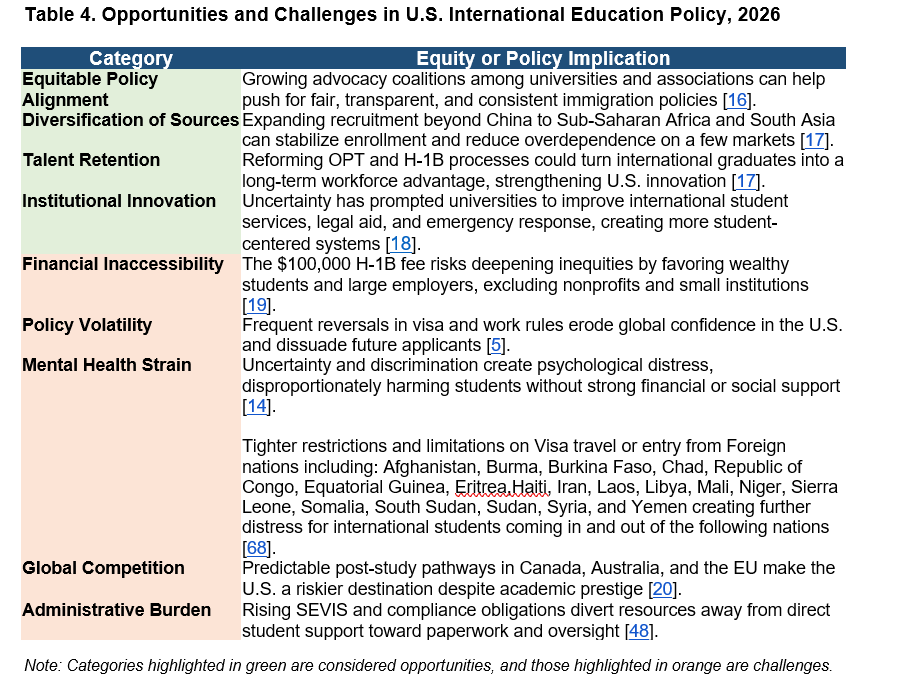
The 2025 U.S. international education landscape balances emerging reform efforts with deepening structural inequities. Expanding advocacy and institutional innovation show promise for more equitable policies, yet rising financial barriers, policy instability, and administrative burdens continue to undermine access and global competitiveness. Persistent uncertainty and mental health strain further expose the human costs of this volatility. Sustaining U.S. leadership will require coordinated, equity-centered reforms that link immigration, labor, and education policy to long-term talent retention and stability.
POLICY IMPLICATIONS
The following recommendations outline a multi-level strategy to restore stability, equity, and competitiveness within U.S. international education policy.
Federal-Level Recommendations
- Reinstate and codify “Duration of Status” to align visa timelines with academic realities and prevent processing backlogs [18, 44]
Codifying Duration of Status (D/S) would reduce uncertainty by aligning immigration status with the real structure of academic programs, where completion timelines can shift due to research requirements, practicum sequencing, thesis/dissertation milestones, or authorized program changes. When students can maintain lawful status through standard academic progress rather than navigating repeated extensions or status disruptions, institutions also spend less time on avoidable compliance troubleshooting. This kind of clarity can reduce bottlenecks caused by unnecessary administrative churn and help stabilize universities' international enrollment planning.
- Restructure the H-1B system into a merit-based model that prioritizes U.S.-trained graduates, ensuring educational investment translates into workforce retention [32, 33]
A merit-based H-1B approach that meaningfully prioritizes U.S.-educated graduates strengthens the policy “return on investment” of U.S. higher education by reducing post-graduation talent loss driven by lottery constraints. The mechanism is simple: graduates trained in U.S. institutions are already embedded in U.S. labor markets and can convert education into measurable productivity more quickly than “cold start” hires. Implementation should specify transparent selection criteria (e.g., degree level, field relevance, labor-market shortage signals, and demonstrated U.S. work experience) to maintain legitimacy and minimize gaming.
Extending dual intent to F-1 students resolves a structural inconsistency in which students must demonstrate temporary intent while policy pathways (e.g., OPT and employer sponsorship) implicitly support longer-term transitions. This reduces risk-avoidant behavior and uncertainty that can distort student decision-making (travel, internships, long-term planning) and can generate arbitrary outcomes due to inconsistent interpretation. A dual-intent framework should be paired with clear compliance expectations so that it increases transparency without weakening enforcement against genuine fraud.
- Protect and strengthen Optional Practical Training (OPT) to secure a critical bridge between education and employment [3, 44]
OPT is the primary labor-market bridge that allows international graduates to translate U.S. training into U.S. work experience, supporting employer hiring pipelines and reinforcing U.S. competitiveness. When OPT becomes unstable, the system creates a “cliff effect” after graduation that reduces the credibility of U.S. education as a pathway to applied talent. Best practice is to preserve OPT while strengthening guardrails: clearer rules, timely processing, employer guidance, and compliance oversight to reduce exploitation and improve program integrity.
State and Local-Level Recommendations
- Offer in-state tuition or scholarship incentives to attract and retain international talent [27]
State-level affordability tools can operate as a talent strategy, not just a recruitment incentive, by linking financial support to workforce participation and regional development goals. Best practice is targeted, transparent programming (e.g., scholarships in high-need fields, internship-linked awards, or retention incentives tied to in-state employment pathways). This strengthens competitiveness against other destination countries while producing more measurable local economic returns.
- Streamline professional licensing processes to facilitate workforce integration
Licensing friction delays workforce entry, increases underemployment, and weakens local talent pipelines even when graduates are qualified and work-authorized. Best practice is administrative clarity: standardized documentation checklists, published review timelines, clear equivalency rules, and, where appropriate, provisional/bridge licensing routes that preserve standards while accelerating integration. This reduces skill waste and helps states meet labor needs in regulated professions.
- Foster partnerships that retain international graduates in local economies, enhancing both regional innovation and national competitiveness [27]
Retention improves when local partners coordinate rather than leaving students and employers to navigate the system on their own. Best practice partnerships include OPT-friendly employer networks, structured internship-to-employment pipelines, and sponsorship readiness supports delivered jointly by universities, workforce boards, and chambers of commerce. This lowers hiring friction for employers and anchors skilled graduates in regional economies, strengthening innovation capacity and long-term competitiveness.
Institutional-Level Recommendations
1. Institutionalize comprehensive support services that address mental health, legal, and financial needs [45, 46, 22]
International student support should be treated as retention and equity infrastructure, not an optional add-on, because policy uncertainty can translate quickly into mental distress, legal confusion, and financial vulnerability. A best-practice model is integrated service delivery (mental health, immigration/legal navigation, and emergency aid) with culturally competent staff and clear referral pathways. This reduces preventable attrition and ensures that students without strong family resources are not disproportionately harmed by administrative or economic shocks.
2. Engage in coordinated advocacy to counter restrictive policy shifts [19, 37]
Coordinated advocacy is more effective than fragmented institutional responses because it aggregates evidence, harmonizes messaging, and increases policy leverage. Institutions should work through coalitions to document impacts (enrollment, workforce pipelines, compliance burden, student well-being) and push for stable, evidence-based administrative guidance rather than reactive rule swings. A best practice is “advance work:”maintain an advocacy playbook, rapid-response messaging, and a standing policy-monitoring team so the sector is not always reacting after damage is done.
3. Diversify recruitment beyond traditional markets and deepen global engagement to bolster institutional resilience [26]
Overreliance on a narrow set of source countries increases vulnerability to geopolitics, exchange-rate shocks, and visa policy changes. Best practice is risk-spreading: diversify recruitment while building durable partnerships (joint programs, exchange pipelines, regional outreach) that strengthen trust and reduce dependence on short-term marketing cycles. Done well, this also advances equity by broadening access beyond elite or historically dominant sending markets.
CONCLUSION
The United States’ leadership in global education is at a critical juncture, threatened not by external forces but by policy volatility. International students are a profound asset, an economic engine, a catalyst for innovation, and a cornerstone of American soft power. Their contributions are immense, totaling $43.8 billion to the U.S. economy in the last academic year alone [27].
However, the current policy approach has created a climate of instability that diminishes the value proposition of U.S. education and potentially signals to the world that America is an unreliable partner. To secure its standing, the U.S. must move beyond, constantly changing and more restrictive measures and adopt a coherent, proactive national strategy that treats international students as a strategic asset, as decades of data has shown them to be. .
Implementing the policy solutions outlined in this report can not only secure the financial health and intellectual vibrancy of U.S. universities, but also enhance student well-being. It can also reinforce the nation’s long-term economic competitiveness, scientific leadership, and fundamental commitment to equity and global engagement.